TWO:On assembling his remnant of an army in Brelowa, Buonaparte beheld a state of general disorganisation prevailing. Perishing with cold and hunger, every man was only mindful of himself. In a short time the whole village was pulled down to make camp-fires of the timber, for the weather was fiercely cold. He could scarcely prevent them from stripping off the roof under which he had taken shelter. He set out on his march for Wilna on the 29th of November. The army hurried along without order or discipline, their only care being to outstrip the Russians, who were, like famished wolves, at their heels; the Cossacks continually cutting down numbers of their benumbed and ragged comrades, who went along more like spectres than actual men. The thermometer was at twenty degrees below zero.
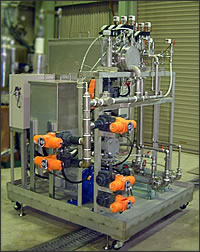
A hydrocyclone (liquid cyclone) injects treatment solution into stationary equipment to perform separation, classification, and concentration, and is an innovative separator with a very simple structure and no drive unit.
Structure of a hydrocyclone (liquid cyclone)
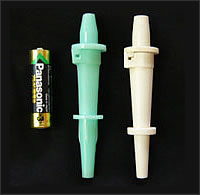
A suspension containing fine particles of several micrometers or more is supplied to a cylindrical container circumferentially at high speed. And as a result it starts to rotate and a centrifugal force is generated. At this time a gravitational acceleration of several tens of thousands of G is generated in the circumferential direction, and thus leading to fast sedimentation and concentration of the fine particles. The separated concentration can be freely selected by changing the supply rate (supply pressure and flow rate) and the flow ratio of the outlet. Our hydrocyclone (liquid cyclone) was designed and manufactured to classify and concentrate fine particles, and so has a small element.
THREE:The first great battle was destined to be fought on the very ground where Gustavus Adolphus fell, 1632. Buonaparte marched upon Leipsic, expecting to find the Allies posted there; but he was suddenly brought to a stand by them at Lützen. The Allies, who were on the left bank of the Elster, crossed to the right, and impetuously attacked the French, whose centre was at the village of Kaya, under the command of Ney, supported by the Imperial Guard, and their fine artillery drawn up in front of the town of Lützen; the right wing, commanded by Marmont, extending as far as the defile of Poserna, and the left stretching from Kaya to the Elster. Napoleon did not expect to have met the Allies on that side of Leipsic, and was pressing briskly forward when the attack commenced. Ney was first stopped at Gross-G?rschen. Had Wittgenstein made a decided charge with his whole column, instead of attacking by small brigades, he would assuredly have broken the French lines. But Buonaparte rode up, and galloped from place to place to throw fresh troops on the point of attack, and to wheel up both of his wings so as to enclose, if possible, both flanks of the Allies. The conflict lasted some[65] hours, during which it was uncertain whether the Allies would break the centre of the French, or the French would be able to outflank the Allies. Blucher was late on the field; the officer who was sent overnight to him with orders from Wittgenstein is said to have put them under his pillow and slept on them till roused by the cannon. At length, after a desperate attack by Napoleon to recover the village of Kaya, out of which he had been driven, the Allies observing that the firing of Macdonald and Bertrand, who commanded the two wings, was fast extending along their flanks, skilfully extricated themselves from the combat, and led back their columns so as to escape being outflanked by the French. Yet they did not even then give up the struggle for the day. The Allied cavalry made a general attack in the dark, but it failed from the mighty masses of the French on which they had to act. The Allies captured some cannon, the French none. The loss of the Allies was twenty thousand men, killed and wounded: that of the French was equally severe. Seven or eight French generals were killed or wounded. On the side of the Allies fell General Scharnhorst¡ªan irreparable loss, for no man had done more to organise the Prussian landwehr and volunteers. The Prince Leopold of Hesse-Homburg and the Prince of Mecklenburg-Strelitz, both allied to the royal family of England, were slain, and Blucher himself was wounded; but he had his wounds dressed on the field, and would not quit it till the last moment.
- Equipment costs can be reduced.
- Operating costs can be reduced.
- Maintenance costs can be reduced.
- Any change in raw material and product can be easily addressed.
- Large amounts can be treated in a small area.
- Separation and cleaning are easy because of the simple structure.
- Simplified control
- This equipment can be operated in synchronization with external devices.
- Alarm and interlock mechanism.
THREE:On the 16th of June, just as the House was growing impatient for prorogation, Lord North, who earlier in the Session had made some unsuccessful negotiations with the Whigs, announced intelligence which put such prorogation out of the question. He informed the House that the Spanish Ambassador had delivered a hostile manifesto and had thereupon quitted London. On the 17th a Royal Message was delivered, asserting his Majesty's surprise at this act of Spain, and declaring that nothing on his part had provoked it. But it by no means took anybody else by surprise, and the Opposition strongly reproached Government for not giving credit to their warnings on this head. In the Commons, Lord John Cavendish, and, in the Lords, the Earl of Abingdon and the Duke of Richmond, moved that the fleet and army should be immediately withdrawn from America, that peace be made with those States, and all our forces be concentrated in chastising France and Spain, as they deserved, for their treachery and unprovoked interference. They called for a total change of Ministers and measures.BARTHOLOMEW FAIR, LONDON, IN 1721. (From a Painting on a Fan.)
- Classification and concentration for the manufacture of inorganic powder materials
- Classification of ceramic materials
- Removal of fine particles, including iron powder
- Removal of fine particles from pigments
- Removal of fine organic particles from solvents
- Separation of starch and yeast
- Removal of fine particles from high-temperature strong acid solutions
- Removal of fine particles from low-temperature solutions